Diploma vs Degree: Which Is Better for Your Career in India?
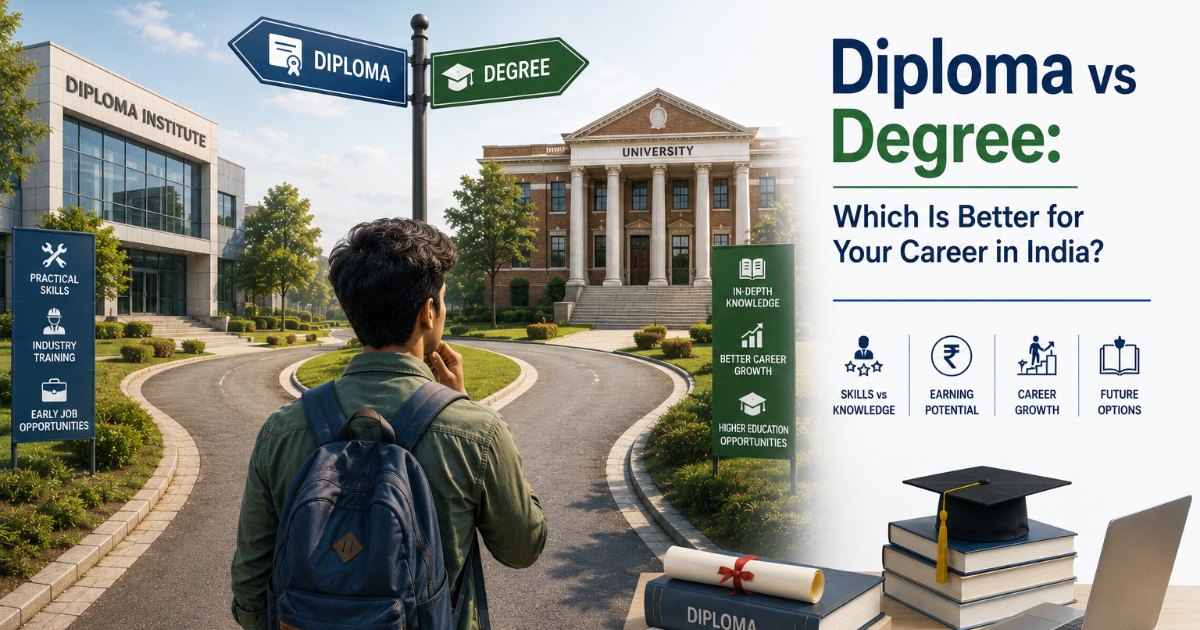
When students and parents weigh a diploma vs degree, the debate usually collapses into a false binary — that a degree is "proper" and a diploma is a fallback. The honest reality is more useful: a diploma and a degree are different tools, built for different goals, budgets and timelines. A diploma gets you job-ready faster and cheaper, often straight after 10th; a degree gives you greater depth and a higher long-term ceiling over three or four years. Crucially, the two are not mutually exclusive — the lateral-entry route lets a diploma-holder step directly into the second year of a degree, so choosing a diploma now does not close the door to a degree later. This guide compares the two on duration, cost, eligibility, job-readiness and long-term prospects, and gives you an honest way to decide which fits your situation.
Diploma vs degree at a glance

A diploma is a focused, skill-oriented qualification, typically running one to three years, often entered straight after 10th (as with polytechnic diplomas) and sometimes after 12th. Its purpose is to make you employable quickly in a specific trade or technical field, with a curriculum that leans practical over theoretical.
A degree — a bachelor's such as a B.Tech, BCA or B.Com — usually runs three to four years, is entered after 12th, and goes deeper into theory and breadth alongside practical work. Its purpose is to build a fuller foundation that supports a wider range of roles and, importantly, postgraduate study and senior progression later.
The honest framing is that the two answer different questions. A diploma answers "how do I become employable in this field as quickly and affordably as possible?". A degree answers "how do I build the deepest foundation for the longest-term career, including higher study?". Neither is superior in the abstract; the right choice depends on what you need from the next few years and where you want to be in ten.
Talk to a CourseLane advisor — free, and no obligation.
What a diploma offers
The diploma's strongest selling points are speed, cost and access. Because many diplomas can be entered after 10th, a student can be qualified and earning while their peers are still completing a degree. Polytechnic diplomas in engineering trades, for example, produce job-ready technicians in around three years, and the fees are typically far lower than an equivalent degree, which matters enormously for students who need to start contributing to family income sooner.
The curriculum is deliberately practical, focused on the specific skills employers in that trade actually use, which can make diploma-holders productive from day one in hands-on roles. For a student who learns best by doing, finds long theory-heavy study draining, and values early independence, this is a genuine strength rather than a compromise.
The honest limitation is the ceiling. A diploma qualifies you for technician and operational roles, and while these can be stable and well-paid with experience, the most senior design, management and specialist positions often expect a degree. That limitation, though, is not permanent — which is where lateral entry changes the calculation entirely.
What a degree offers
A degree's advantage is depth, breadth and the higher ceiling they unlock. Over three or four years, a degree such as B.Tech in Computer Science covers not just how to do a task but the underlying theory, which is what lets graduates move into design, research, specialisation and leadership over a career. Many senior, specialist and management roles, and almost all postgraduate study, are gated behind a bachelor's degree.
A degree also tends to carry broader recognition with employers and to open a wider initial set of roles, including those in fields adjacent to the core subject. The trade-offs are time and money: a degree takes longer before you start earning and usually costs more, and that delay only pays off if the degree leads somewhere you genuinely want to be.
The honest point is that a degree is an investment in long-term range and progression rather than in the fastest possible entry to work. For students who want to keep the broadest options open, pursue higher study, or aim at roles that compound in seniority over decades, the extra time and cost are usually worth it.
Diploma vs degree: the head-to-head
The table below compares the two on the factors that usually decide the choice. Weigh the rows by your own situation — particularly your budget and how soon you need to earn.
| Factor | Diploma | Degree |
|---|---|---|
| Typical duration | 1–3 years | 3–4 years |
| Entry point | Often after 10th | After 12th |
| Focus | Practical, job-ready skills | Theory + breadth + practice |
| Cost | Lower | Higher |
| Time to first job | Faster | Slower |
| Long-term ceiling | Technician/operational, rises with experience | Higher — senior, specialist and PG routes |
| Bridge | Lateral entry into a degree's 2nd year | Leads to postgraduate study |
The pattern is consistent: the diploma optimises for speed and affordability, the degree for depth and long-term progression. The lateral-entry row is the one most people overlook, and it is the key to having both.
The lateral-entry bridge most people miss
The single most useful fact in this whole comparison is that a diploma and a degree are not a permanent either-or. Through lateral entry, a diploma-holder can be admitted directly into the second year of a related degree, skipping the first year. This means a student can take a polytechnic diploma after 10th, start earning or gain practical experience, and later complete a full degree in less total time than starting from scratch.
This route transforms the diploma from a dead end into a stepping stone. It suits students who need to start earning early but do not want to give up the higher ceiling a degree provides, letting them build skills and income first and add the degree's depth when they are ready and can afford it. The practical details — which degrees accept lateral entry, the entrance process and seat availability — vary, so verify them for the specific course and college before relying on the route.
The honest takeaway is that the diploma-versus-degree choice is rarely final. For many students the smartest path is sequential — a diploma first for speed and affordability, then a degree by lateral entry for depth — rather than a single irreversible decision made at 16.
Which pays more, and the honest caveats
On pay, the honest answer is that degrees tend to have a higher long-term ceiling, while diplomas can win on early earnings simply because the holder enters the workforce sooner. A diploma-holder may be earning for two or three years while a degree student is still studying, and in some practical trades experienced diploma technicians earn very respectably. Over a full career, though, the senior and specialist roles that pay the most more often expect a degree.
But pay is only part of the picture, and comparing headline salaries misses the point. A degree pursued half-heartedly in a field you dislike is a poor investment despite its higher ceiling, while a diploma in a trade you enjoy and excel at can lead to a stable, satisfying and well-paid working life. The same honest discipline that should guide any education decision — covered in our guide to how to choose a college — applies here: judge the specific course and institution, not the category.
The deeper caveat is fit and finances. If money is tight and you need to earn soon, a diploma with a lateral-entry option later is often the wiser route than taking on debt for a degree you may struggle to finish. If you can afford the time and want the broadest long-term range, a degree earns its extra cost. Decide by your real constraints, not by which qualification sounds more prestigious.
Diploma vs degree: the honest bottom line
Strip away the stereotypes and the diploma vs degree decision comes down to your goals, your budget and your timeline — not to which qualification carries more social prestige. The honest verdict of any fair diploma vs degree comparison is that neither wins outright: a diploma optimises for speed and affordability, a degree for depth and a higher long-term ceiling, and the lateral-entry route lets you have both in sequence. The right answer is simply the one that fits your situation now.
If you need to start earning soon, value hands-on learning and want to keep costs low, a diploma — often a polytechnic diploma entered after 10th — is a smart, legitimate choice rather than a fallback. If you can afford the extra years and want the broadest long-term range, senior roles or postgraduate study, a degree earns its higher cost. And because lateral entry bridges a diploma into the second year of a degree, choosing a diploma first rarely closes the door on a degree later, which takes much of the pressure out of the diploma vs degree decision.
So treat diploma vs degree not as a permanent verdict on your ability, but as a practical question of sequencing and fit. Judge the specific course and college rather than the category, weigh the cost against the realistic outcome, and remember that many successful careers begin with a diploma and add a degree later. The qualification you can complete and build on will always beat the one chosen for its label alone.
A step-by-step way to decide
To turn this into a clear decision, work through your actual situation rather than the stereotypes around each qualification.
- Clarify your goal — earn as soon as possible, or build the deepest long-term foundation?
- Be honest about budget — can you afford three to four years of study before earning?
- Consider how you learn — hands-on and practical, or comfortable with extended theory?
- Check lateral entry for any diploma you are considering, so you keep the degree door open.
- Compare the specific courses and colleges on CourseLane rather than judging by category.
- Confirm fit with a quick assessment before committing.
If you are still unsure, a short career-counselling session with our partner can help you weigh a faster, job-ready diploma against a deeper degree in light of your goals and constraints. Remember that the choice is rarely permanent — with lateral entry, a diploma today can still become a degree tomorrow.
Sources & official references
The figures and rules above are drawn from official Indian education authorities. Always confirm the latest details on these sources before you decide:
How CourseLane can help you decide
Choosing well comes down to finding your best-fit career path. Our career counselling page sets out the options for matching your interests and aptitude to the right courses, and you can compare colleges and indicative fees on officially-sourced data across the CourseLane colleges directory.
Written and fact-checked by the CourseLane Editorial team and reviewed by the CourseLane Research Team. CourseLane sources figures from official authorities such as NIRF, AICTE and UGC, labels indicative ranges clearly, and never fabricates data.
Talk to a CourseLane advisor — free, and no obligation.
Frequently asked questions
What is the difference between a diploma and a degree?
A diploma is a shorter, skill-focused qualification of about one to three years, often entered after 10th, that makes you job-ready quickly and cheaply. A degree is a three- to four-year bachelor's, entered after 12th, that goes deeper into theory and breadth and supports senior roles and postgraduate study. In short, a diploma optimises for fast, affordable entry to work, while a degree optimises for depth and a higher long-term ceiling.
Is a diploma better than a degree?
Neither is universally better; they suit different goals. A diploma is better if you want to become employable quickly, spend less, or start earning sooner, and it can later bridge into a degree through lateral entry. A degree is better if you want the broadest long-term range, higher senior and specialist roles, or postgraduate study. The right choice depends on your budget, how you learn and where you want to be in ten years.
Can I do a degree after a diploma?
Yes. Through lateral entry, a diploma-holder can be admitted directly into the second year of a related degree, skipping the first year and saving time overall. This makes a diploma a stepping stone rather than a dead end — you can take a diploma after 10th, start earning or gaining experience, and complete a full degree later. The exact courses that accept lateral entry and the entrance process vary, so verify them for your specific college.
Which pays more, a diploma or a degree?
It depends on the timeframe. A diploma-holder often earns sooner, since they enter the workforce earlier, and experienced technicians in practical trades can earn very respectably. Over a full career, however, degrees tend to have a higher ceiling because the most senior, specialist and management roles usually expect one. Pay should not be judged on headline figures alone — fit, the specific field and whether you finish the course matter more than the category.
Is a diploma valuable in India?
Yes, a diploma is genuinely valuable in India, especially as the country has invested heavily in skilling and job-ready education. A diploma can lead directly to employment in a specific trade or technical field, costs less than a degree, and can bridge into a full degree later through lateral entry. Its main limitation is a lower ceiling for the most senior roles, but that is not permanent given the lateral-entry route into a degree.