How to Choose a Stream After 10th: Science, Commerce or Arts
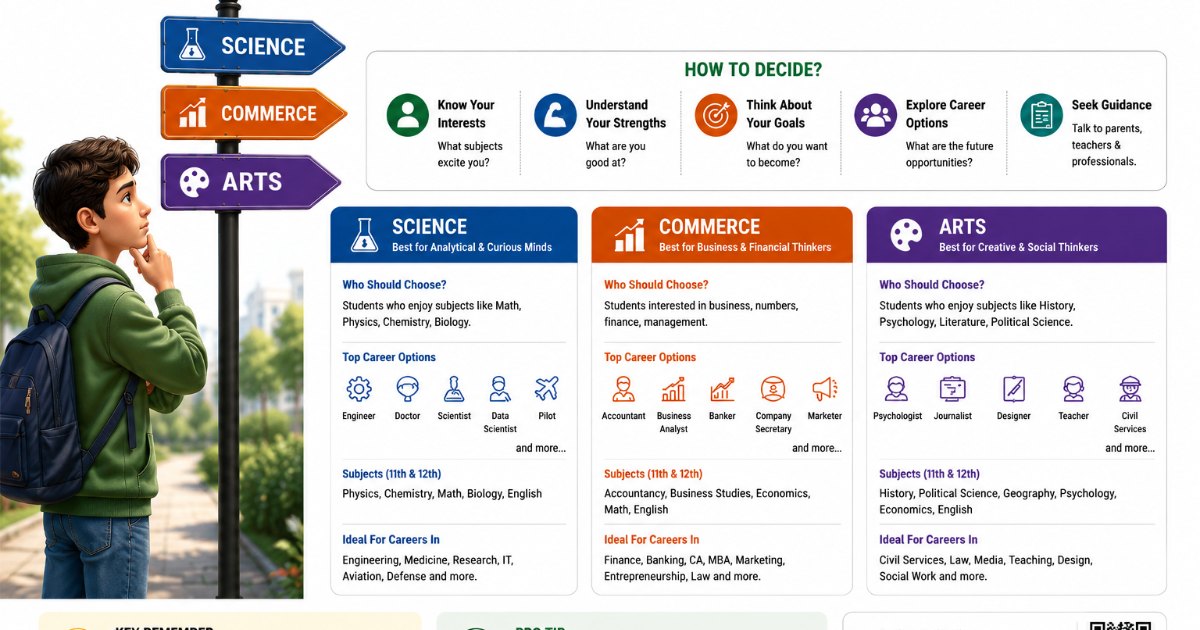
The choice you make after 10th — Science, Commerce, Arts or a vocational track — feels enormous, and the pressure around it often makes it harder than it needs to be. The honest truth is that this decision shapes your next two years and the entrances you can sit, but it does not seal your career for life. Knowing how to choose a stream after 10th comes down to a calm, fit-first process: understanding what each stream actually contains, where it genuinely leads, and which one matches your interest and aptitude rather than your friends' choices or a family assumption about prestige. This guide gives you that framework, busts the myth that one stream is inherently superior, and shows you how the streams connect to real careers so you can decide with confidence instead of fear.
The one mistake that derails this decision

The single biggest error students make is choosing a stream by prestige or pressure rather than by fit. Science is too often picked because it is seen as the "intelligent" choice, or because a parent or peer group expects it, even when the student has no real interest in physics, chemistry or maths. The result is predictable: a difficult two years, dropping confidence, and sometimes a forced switch later that costs time and morale.
The honest reframing is that there is no superior stream, only a stream that suits you. Commerce produces chartered accountants, economists and entrepreneurs; arts produces lawyers, civil servants, designers and psychologists; science produces engineers, doctors and researchers. Each leads to respected, well-paid careers. What separates a good outcome from a poor one is not the stream's prestige but whether you can sustain it with genuine interest, because the streams that demand the most — particularly science — punish a lack of motivation quickly.
So begin not with "which stream is best" but with "which stream fits how I think and what I enjoy". That shift, made calmly before the marks come in, is what protects you from a choice you will want to undo.
Talk to a CourseLane advisor — free, and no obligation.
What each stream contains and where it leads
Before choosing, it helps to know what you are actually signing up for and where it goes. Science covers physics and chemistry with either maths (PCM) or biology (PCB), and it is the gateway to engineering through exams like JEE, to medicine through NEET, and to research and technology. Its honest map of outcomes is laid out in our guide to career options after 12th science.
Commerce covers accountancy, business studies and economics, and it leads to B.Com, BBA, the professional route of CA, CS and CMA, and onward to finance, analytics and management. The full landscape is mapped in career options after 12th commerce. Arts (Humanities) covers subjects like history, political science, psychology, sociology and literature, and it is the base for law, the civil services, design, journalism and the social sciences, detailed in career options after 12th arts.
The practical point is that every stream opens a genuinely broad set of careers, and none of them is a dead end. Reading where each actually leads — rather than relying on stereotypes — is the fastest way to see which landscape excites you, and that excitement is the most reliable signal you have about fit.
"Science keeps all doors open" — honestly examined
You will hear, repeatedly, that science keeps every option open while commerce and arts close doors. This is partly true and largely overstated. It is true that a science student can later move into commerce or arts at the degree stage, and that some career routes — engineering and medicine in particular — are only reachable through science at 12th. So if you are genuinely undecided and can comfortably handle the workload, science does preserve the widest set of entrance options.
But the claim becomes harmful when it pushes a reluctant student into science purely to "keep options open". A student who takes science without interest, struggles through the boards, and then switches to a commerce or arts degree anyway has gained little and lost two hard years. Meanwhile, a commerce or arts student can still reach management, law, civil services, design, finance and most non-technical careers without ever touching science.
The honest version of the rule is this: science keeps the most technical doors open, and is the right hedge only if you can sustain it and might want engineering or medicine. If you already lean towards business, law, design or the humanities, choosing commerce or arts is not closing doors — it is opening the right ones sooner.
The maths question and the choice within science
Two specific questions trip up many families. The first is maths. Commerce can be taken with or without maths, and the choice matters: commerce with maths keeps economics, finance, data and many professional routes fully open, while commerce without maths is still perfectly viable for B.Com, CA and business, with comfort in numbers mattering more than the formal subject. If you have any analytical leaning, commerce with maths is the safer pick.
The second is the split within science between PCM and PCB. PCM (with maths) points towards engineering, architecture and technology and the JEE route; PCB (with biology) points towards medical and life-science careers and the NEET route. Some boards allow PCMB, taking both maths and biology, which keeps engineering and medicine open at the cost of a heavier load. This is a big enough decision on its own that it deserves its own honest comparison before you commit.
The thread running through both questions is the same: do not drop a subject that keeps a door you might want, but do not carry a punishing load for a door you will never walk through. Match the combination to the entrance you are genuinely willing to prepare for.
Vocational and skill tracks are legitimate
One option families routinely overlook is the vocational or skill route — polytechnic diplomas, ITI trades and skill-based programmes that lead to employment faster than a traditional degree. These tracks have shed much of their old stigma as India has invested heavily in skilling, and for a hands-on student who wants to earn sooner, they can be a genuinely smart choice rather than a fallback.
A diploma after 10th, for instance, can lead directly to a job and can later bridge into a full degree through lateral entry, so the route does not foreclose higher study. The honest framing is that the academic streams and the vocational tracks are different tools for different temperaments, not a ladder with vocational at the bottom. A student who learns by doing, dislikes long theory-heavy study and wants early independence may thrive on a skill route where they would have languished in an ill-fitting academic stream.
The point is to widen the menu beyond the three classic streams before deciding, so the choice reflects how you actually learn and what you want from the next few years.
Can you change your stream later?
Because the decision feels so final, it is worth stating plainly: stream changes are possible, just unevenly so. Moving from science to commerce or arts at the degree stage is common and straightforward, since those degrees rarely require a science background. Moving the other way — from commerce or arts into engineering or medicine — is much harder, because those fields need science subjects at 12th. Within the same school, switching streams immediately after choosing is sometimes allowed in the first few weeks, but rarely after that.
So the asymmetry is real but manageable. If you are genuinely torn and could see yourself in a technical field, leaning science gives you the easier exit routes. If you are reasonably clear that your future is in business, law, design or the humanities, there is no need to take science as insurance against a door you do not intend to open.
The reassuring truth is that careers today are far less linear than the stream choice suggests. Many people end up in fields only loosely connected to their 12th stream, and skills, further degrees and genuine interest carry more weight over a working life than the subject combination you picked at fifteen.
A step-by-step way to choose
With the pressure stripped away, a simple sequence makes the decision manageable. Work through it honestly rather than rushing to the option that sounds most impressive.
- Start from interest and aptitude — which subjects do you actually enjoy and do well in, setting prestige aside?
- Read where each stream leads using the three career maps above, and notice which landscape excites you.
- Check the entrance match — if you want engineering or medicine, you need science; if you want business or the humanities, you do not.
- Resolve the maths and PCM/PCB questions by the doors you might want, not by avoiding effort.
- Consider vocational routes if you learn best by doing and want to earn sooner.
- Confirm fit with a quick aptitude check before you commit.
If the choice still feels heavy, a short career-counselling session with our partner can match your interests and aptitude to the stream that genuinely suits you, which is far more useful than following a friend or a family assumption. Choose the stream you can sustain with real interest, and trust that fit, not prestige, is what turns a stream into a strong career.
Sources & official references
The figures and rules above are drawn from official Indian education authorities. Always confirm the latest details on these sources before you decide:
How CourseLane can help you decide
Choosing well comes down to finding your best-fit education path. Our career counselling page sets out the options for matching your interests and aptitude to the right courses, and you can compare colleges and indicative fees on officially-sourced data across the CourseLane colleges directory.
Written and fact-checked by the CourseLane Editorial team and reviewed by the CourseLane Research Team. CourseLane sources figures from official authorities such as NIRF, AICTE and UGC, labels indicative ranges clearly, and never fabricates data.
Talk to a CourseLane advisor — free, and no obligation.
Frequently asked questions
How do I choose a stream after 10th?
To choose a stream after 10th, start from your genuine interest and aptitude rather than prestige or pressure. Understand what each stream contains and where it leads — Science to engineering, medicine and research; Commerce to accounting, finance and business; Arts to law, civil services, design and psychology — then match it to the careers and entrances that excite you. The stream you can sustain with real interest is the right one, because motivation matters far more than a stream's reputation.
Which stream is best after 10th?
There is no single best stream; the best stream is the one that fits you. Science suits students drawn to physics, maths or biology and aiming at engineering, medicine or research; Commerce suits those interested in business, accounting and finance; Arts suits those drawn to law, the civil services, design, psychology and the humanities. Each leads to respected, well-paid careers, so judge by fit rather than by which sounds most prestigious.
Can I take PCM and commerce together?
Officially, yes. CBSE requires only English plus four more subjects (a minimum of five, up to nine), and NEP 2020 has loosened the rigid Science/Commerce/Arts labels, so Physics, Chemistry and Maths with a commerce elective like Accountancy, Business Studies or Economics is allowed on paper. In practice, though, most schools timetable subjects in fixed stream blocks, so the mix runs only if your particular school actually offers and schedules it — confirm with them before you count on it. It is also a heavy load, so take it for a clear reason rather than just to keep every door open.
Can I change my stream later?
Yes, you can change your stream, but unevenly. Moving from science to commerce or arts at the degree stage is common and easy, since those degrees rarely need a science background. Moving from commerce or arts into engineering or medicine is much harder, because those fields require science subjects at 12th. Within school, an immediate switch is sometimes allowed in the first few weeks. Careers are also far less linear than the stream choice suggests.
Does commerce need maths?
Commerce can be taken with or without maths, and the choice matters. Commerce with maths keeps economics, finance, data and several professional routes fully open and is the safer pick if you have any analytical leaning. Commerce without maths is still perfectly viable for B.Com, CA and general business, where comfort with numbers matters more than the formal subject. If in doubt, keeping maths preserves the widest set of options.