NEET vs JEE: Which Path Is Right for You?
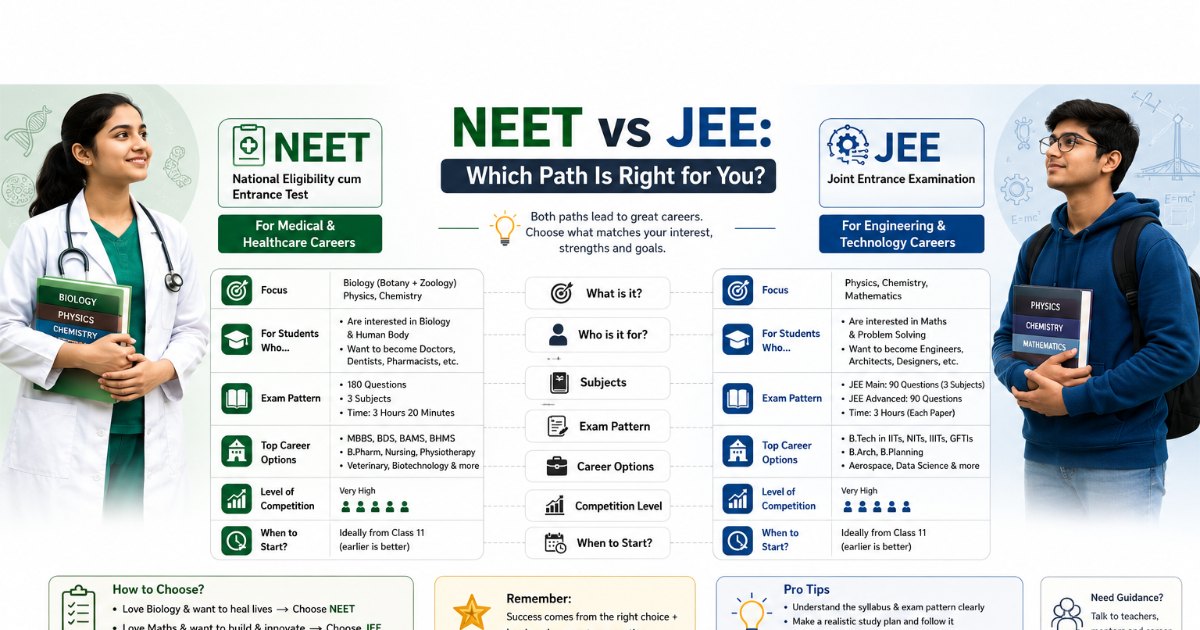
The NEET vs JEE decision is one of the heaviest choices a science student makes after Class 12, and it deserves an honest look rather than a prestige contest. NEET-UG is the single gateway to MBBS and other medical courses, while JEE opens engineering at the IITs, NITs and beyond — two very different careers with different exams, timelines and rewards. This guide compares them plainly so you can decide by genuine interest and aptitude, not by which sounds more impressive.
What NEET and JEE actually are
NEET-UG (the National Eligibility cum Entrance Test) is conducted by the National Testing Agency (NTA) and is the single entrance for MBBS, BDS and most other medical and AYUSH courses in India. It is one pen-and-paper paper drawn from Physics, Chemistry and Biology — the PCB combination — so it suits students who took biology in Class 11 and 12. There is no second stage: your single NEET score, and the rank it produces, decides which colleges and courses you can access through counselling.
JEE is the route into engineering and is run in two stages. JEE Main, also conducted by the NTA, covers Physics, Chemistry and Mathematics — the PCM combination — and opens the NITs, IIITs, GFTIs and many state and private institutions. The top performers in JEE Main then qualify to sit JEE Advanced, conducted by the IITs themselves, which is the only gateway to the 23 IITs. So the two exams split cleanly along your Class 11–12 subjects: biology points you to NEET, mathematics points you to JEE.
Both systems are administered under regulators whose data you can trust. The NTA runs the tests; the National Medical Commission (NMC) governs MBBS seats and medical colleges; and AICTE and UGC oversee technical and university education. Because these official bodies publish seat numbers and standards, you can ground this decision in real figures rather than coaching-centre marketing — which is exactly what the honest comparison below does.
One more structural difference is worth noting early. NEET is a single shot per cycle: your one paper, on one day, sets your rank for the entire counselling season, which raises the stakes on exam-day composure. JEE spreads the load slightly — JEE Main is held in multiple sessions and the better score counts, before the separate JEE Advanced — so the format itself rewards different temperaments. A student who performs best under a single decisive test may suit NEET's structure, while one who benefits from a staged, two-attempt path may find JEE's format less punishing.
Talk to a CourseLane advisor — free, and no obligation.
NEET vs JEE: exam structure and difficulty compared
The honest answer to 'which is tougher' is that they are hard in different ways, and the NEET vs JEE difficulty debate has no single winner. NEET rewards breadth, accuracy and stamina across a very large syllabus — a small number of careless errors can cost thousands of ranks because so many candidates cluster at high scores. The biology section alone demands enormous factual recall, and at the top of the merit list a single extra mistake separates a government MBBS seat from a private one.
JEE, especially JEE Advanced, rewards depth and multi-step problem-solving. Its questions are deliberately unpredictable and test how you apply concepts under pressure rather than how much you can recall. Many students find JEE Advanced the harder paper to crack because you cannot prepare for the exact problems; you can only build the reasoning to handle whatever appears. NEET is more about flawless execution of a known syllabus, JEE more about adaptable thinking.
Here is a plain comparison of the two:
| Feature | NEET-UG | JEE (Main + Advanced) |
|---|---|---|
| Subjects | Physics, Chemistry, Biology (PCB) | Physics, Chemistry, Mathematics (PCM) |
| Structure | Single national paper (NTA) | JEE Main (NTA) → JEE Advanced (IITs) |
| Tests mainly | Recall, accuracy, stamina | Conceptual depth, problem-solving |
| Number of attempts/stages | One paper decides the rank | Two-stage; Main qualifies you for Advanced |
| Leads to | MBBS, BDS, AYUSH and allied courses | B.Tech at IITs, NITs, IIITs and more |

The scale tells the story. Around 20 lakh candidates registered for NEET-UG against roughly 1.3–1.4 lakh MBBS seats across the country, while JEE Advanced sees over 1.7 lakh candidates competing for about 18,000 IIT seats (with many more engineering seats available through JEE Main at NITs and other institutions). Whichever path you pick, the selection ratio is low and the preparation is gruelling — so the deciding question is not which exam is easier, but which subject you can sustain two years of intense study in without burning out.
The MBBS path: long, costly and demanding
If NEET leads where you want to go, be clear-eyed about the road. MBBS is a 5.5-year degree including a one-year compulsory rotating internship, and for most competitive careers it is only the beginning. A postgraduate degree (MD or MS) through the equally brutal NEET-PG entrance usually follows, adding three or more years, and super-specialisation adds more still. From the day you sit NEET-UG to a settled specialist career can realistically take a decade.
Cost varies enormously and matters more than students expect. Government medical college fees are modest, which is exactly why competition for those seats is ferocious. Private MBBS seats, by contrast, can run into tens of lakhs across the full course, and deemed-university or management-quota seats higher still — so families need to plan finances honestly before committing. It is not unusual for the total cost of a private MBBS to exceed that of several other professional degrees combined.
There are licensed alternatives within the same NEET stream worth knowing about, and they matter because most NEET aspirants will not secure an MBBS seat given the ratio of candidates to places. BDS (dentistry) is a shorter route to a clinical practice for some NEET qualifiers, with its own scope and economics, and AYUSH courses (BAMS, BHMS) also admit through NEET-UG. Planning for these alternatives in advance — rather than treating them as a disappointment if MBBS does not come through — is part of approaching the medical path realistically.
What medicine as a whole rewards is stamina, attention to detail and a genuine care for people. The hours are long, the responsibility is real and immediate, and the deepest satisfaction comes from clinical work and patient outcomes rather than from how quickly you start earning. The path also asks for emotional resilience: you will work with people at their most vulnerable, often through tiring shifts. If that pull towards medicine is genuine, the length and cost are worth it; if it is not, no amount of prestige or family expectation will carry you through the years it demands.
The engineering path: broad and faster to evolve
Engineering through JEE is shorter and considerably wider. A B.Tech is a four-year degree, after which you can enter industry directly without a mandatory postgraduate qualification, and the field spans dozens of specialisations rather than a single profession. That breadth is engineering's great advantage: a strong problem-solver can move between software, hardware, data, core engineering, research, product and even management roles across a career, often without retraining from scratch.
The field also adapts quickly to where the world is heading. Newer programmes such as a B.Tech in AI and Machine Learning now sit alongside traditional branches like mechanical, civil and electrical, and curricula track emerging areas — AI, robotics, clean energy, semiconductors — faster than most degrees can. Engineering rewards logical problem-solving, comfort with mathematics, and a willingness to keep learning as tools and entire sub-fields change every few years.
The honest trade-off is that engineering outcomes vary widely by institute and by branch. An IIT or top-NIT computer-science seat opens very different doors from a lesser-known college's least-demanded branch, and the placement gap between them is large. So 'doing engineering' is not one decision but several layered choices: which branch, which college, and how the placements in that specific branch actually look. A general B.Tech from a weak college with poor placements is a very different proposition from a CSE seat at a top institute — and the entrance rank is what determines which you can reach.
This matters when you weigh JEE against NEET, because the two systems distribute risk differently. NEET leads to a tightly regulated profession with a clear, if long, path; an MBBS doctor's role is well defined wherever they qualify. Engineering offers more upside and more flexibility, but the value of the degree depends heavily on the branch and college you land, which in turn depends on your rank. Going in with open eyes about that spread — rather than assuming any B.Tech guarantees a strong outcome — is part of choosing the engineering path honestly.
Realistic pay and career scope on both sides
An honest pay comparison resists a clean winner, because the two careers earn on very different curves. A fresh computer-science engineer from a strong college might earn an indicative ₹4–12 lakh per year, with the top of that range concentrated in a handful of elite institutes and the most in-demand branches. Many engineering freshers from average colleges earn well below that, and across the board pay scales with skill, branch and employer far more than with the degree certificate alone. Engineering's earnings are front-loaded — you can start earning at 22 — but they are also highly uneven.
A salaried MBBS doctor's pay typically starts more modestly and rises substantially with postgraduate specialisation and clinical experience. A specialist's long-run earning can be very strong, and private practice can add to it, but that income arrives later and only after several more years of study and low-paid junior roles. So the pattern is roughly this: engineering can pay sooner and more variably, while medicine often pays well later and more steadily, alongside high job security and considerable social standing.
It is also worth separating early pay from lifetime earning. Engineering's salary spread is enormous: a top-institute CSE graduate and an average-college graduate in a low-demand branch can begin careers several times apart, and the gap often widens. Medicine's spread is narrower at entry but its ceiling, for a well-established specialist or surgeon, is high and durable, with strong demand that does not fluctuate with tech hiring cycles. Each profession also carries non-financial returns — engineering its flexibility and pace of change, medicine its security and the standing of a respected, regulated profession.
Neither field is a guaranteed fortune, and that is the point. Both have crowded entry levels and reward genuine skill, persistence and good decisions about where you train. The students who chase the higher headline number without the underlying interest are the most likely to end up in a career they resent — half-hearted in a field that punishes anything less than full commitment. Pay should inform the decision, but it cannot be the whole of it.
Can you prepare for NEET and JEE together?
It is technically possible — Physics and Chemistry overlap between the two exams — but it is rarely wise, and most experienced teachers advise against it. NEET needs Biology and JEE needs Mathematics, so attempting both means carrying two extra heavy subjects and splitting your focus during the most demanding years of school. Most students who try to hedge their bets end up under-prepared for both papers, because each exam rewards a fundamentally different style of thinking and practice.
The overlap is also more apparent than real. NEET Physics and JEE Physics are pitched at different depths and question styles; the same is broadly true of Chemistry. Preparing for the harder JEE version does not automatically prepare you for the recall-and-speed demands of NEET, and vice versa. The hours you would spend reconciling two approaches are hours not spent mastering either.
A better approach is to decide early and commit. If you are genuinely undecided between medicine and engineering, resolve the direction in Class 11 rather than spreading yourself across PCB and PCM — and if you must keep both subjects open, treat one exam as primary and the other as a fallback, not as an equal effort. If the indecision is real, a structured career-counselling session with our partner can help you see whether medicine or engineering genuinely fits your interests and aptitude before you commit two years and significant coaching expense to one track. Deciding on evidence beats deciding on prestige or family pressure.
How to decide between NEET and JEE
Strip away the prestige and ask three honest questions. First, which subjects do you actually enjoy and do well in — biology and the workings of the human body, or mathematics and abstract problem-solving? Your natural pull towards one subject is the single most reliable signal you have. Second, can you commit to the long, people-facing medical path with its years of postgraduate study, or do you want a broader, faster-evolving field where you can start working sooner? Third, what does your family's budget realistically support, given that private MBBS can be very expensive while government seats are fiercely contested?
Use this simple guide once you have answered those questions honestly:
- Choose NEET if you are drawn to medicine and patient care, enjoy biology, and can commit to a long path and its cost and timeline.
- Choose JEE if you enjoy mathematics and problem-solving and want broader, faster-evolving options across many engineering fields.
- Choose neither blindly because of prestige, family pressure, peer choices or a friend's plan — the wrong fit wastes the very years that matter most.
Signs that medicine may fit you: you enjoy biology and the workings of the human body, you are patient and steady under pressure, you genuinely want to care for people, and you accept a long road to a settled career. Signs that engineering may fit you: you enjoy mathematics and breaking problems into steps, you like building and improving things, you adapt happily to new tools, and you value flexibility and an earlier start to your working life. Few students fit one list perfectly, but the direction you lean towards is usually clear once you answer honestly rather than aspirationally.
Both NEET and JEE are demanding, both are brutally competitive, and both can lead to genuinely excellent careers for the right person. The mistake is treating one as objectively superior; the better one is simply the one that matches you. Explore the actual courses each exam opens — from MBBS and BDS on the medical side to a B.Tech in CSE or B.Tech in AI and ML on the engineering side — line them up against your genuine interest and aptitude, and let that, not the badge, settle the choice. Whichever you choose, commit fully — the students who succeed at either exam are rarely the most talented, but almost always the ones who picked a direction they believed in and then prepared with consistency over two hard years.
Sources & official references
The figures and rules above are drawn from official Indian education authorities. Always confirm the latest details on these sources before you decide:
How CourseLane can help you decide
Choosing well comes down to finding your best-fit degree course. Our career counselling page sets out the options for matching your interests and aptitude to the right courses, and you can compare colleges and indicative fees on officially-sourced data across the CourseLane colleges directory.
Written and fact-checked by the CourseLane Editorial team and reviewed by the CourseLane Research Team. CourseLane sources figures from official authorities such as NIRF, AICTE and UGC, labels indicative ranges clearly, and never fabricates data.
Talk to a CourseLane advisor — free, and no obligation.
Frequently asked questions
Is NEET tougher than JEE?
They are difficult in different ways, so there is no single winner. NEET tests breadth, accuracy and stamina across a huge syllabus where small errors cost thousands of ranks, while JEE Advanced tests conceptual depth and multi-step problem-solving on unpredictable questions. Both are brutally competitive, with low selection ratios on either side.
Can I prepare for both NEET and JEE together?
It is technically possible because Physics and Chemistry overlap, but it is rarely wise. NEET also needs Biology and JEE needs Mathematics, so doing both splits your focus across two extra heavy subjects during the most demanding school years, and the overlapping subjects are pitched differently in each exam. Most students are better off committing early to one direction.
Which has better career scope — medical or engineering?
Neither has objectively 'better' scope — they lead to different careers. Medicine offers a long, secure, people-facing path that rewards specialisation, while engineering offers breadth across many fields and adapts quickly to areas like AI. The better scope is simply the one that matches your genuine interest and aptitude.
Which earns more, a doctor or an engineer?
It depends on timing and path, not a simple ranking. A strong engineering graduate can earn sooner, with indicative CSE fresher pay around ₹4–12 lakh concentrated in top institutes, while a salaried doctor usually starts more modestly and earns well later after postgraduate specialisation and experience. Neither field guarantees high pay without genuine skill.
How do I decide between NEET and JEE?
Decide by interest and aptitude rather than prestige. Ask which subjects you truly enjoy — biology or mathematics — whether you can commit to the long, costly medical path, and what your family budget supports. If you are genuinely unsure, a structured assessment can clarify the fit before you commit two years of preparation to one track.